The hearing test
SampleHearing test
- Triggered by
- Audiogram recorded at the visit
- amplifyOMS sent
- Visit outcome and recommendation saved to the patient record (In the record)
- Outcome
- Recommended a fitting
- Done by
- Patient record

Growth Engine
The Growth Engine inside amplifyOMS runs twelve Modules tuned to how hearing care actually works. Tested-not-treated patients re-engage. Warranty expirations stop slipping. Upgrade-eligible patients hear from you at the point you decide they're ready. Cleaning reminders fire on your cadence. Educational nurture keeps the inbox warm. All of it configured for your practice and running against your patient data.
Every hearing care practice has the same problem at scale. Patients tested last year and didn't come back. Patients fitted three years ago whose warranty expired last month. Patients whose hearing aids are aging into upgrade eligibility but nobody on the team has time to call them. Patients who left a review opportunity on the table because nobody asked. The patient relationships are real. The lifecycle revenue is real. What's missing is the system that surfaces the right patient to the right touchpoint at the right moment.
Practice owners build patchwork systems to address this. Spreadsheets that track upgrade-eligible patients. Sticky notes on the front desk. A staff member assigned to call last year's tested-not-treated list once a quarter when they have time. These patchwork systems work until they don't, they don't scale past one location, and they fail the moment the staff member who maintained them leaves.
The Growth Engine replaces the patchwork.
The Growth Engine is the lifecycle automation layer inside amplifyOMS. It runs against your patient data, so every Module knows which patients qualify for which touchpoint at which moment. The twelve Modules currently in production cover the full hearing care lifecycle: patient recapture, post-fitting care, retention, and upgrade and database revenue.
Each Module is shaped by people who have run hearing care practices. The descriptions, the cadence guidance, and the warnings about which Modules combine well and which ones don't (Service Reminders and Cleaning Reminders can be too much together if you run them on the same cadence) all come from that experience. This is the kind of guidance that doesn't exist in generic marketing automation platforms because the people building those platforms have never run a clinic.
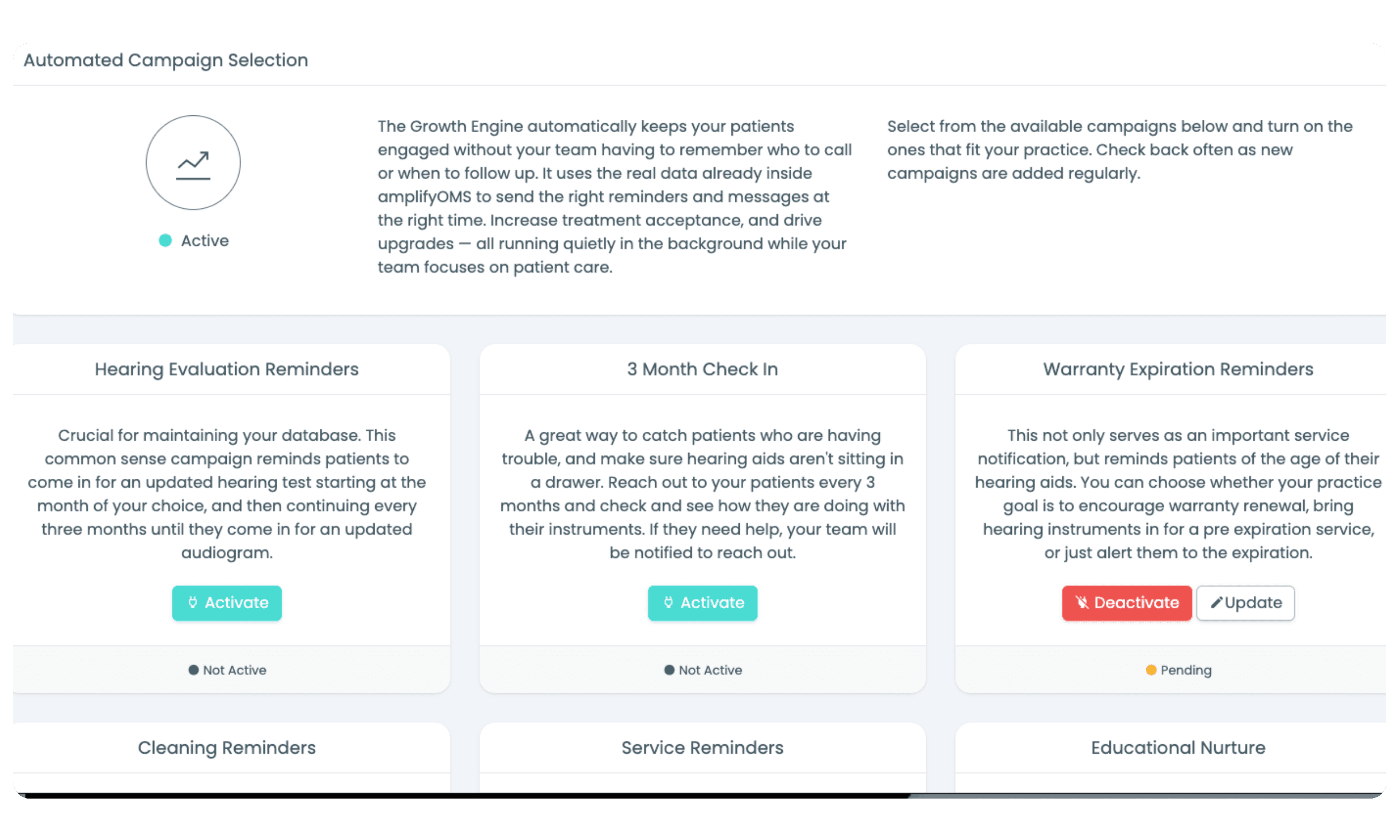
The twelve Modules group naturally by where in the patient lifecycle they fire. Four stages, twelve Modules.
Two Modules pull patients back who tested but didn't come back, or tested but didn't buy.
Recapture cadence for patients whose last hearing test is aging past the threshold you set. It fires every three months until the patient comes in for an updated audiogram, then resets when that audiogram is recorded. Nothing requires staff intervention once the threshold is set.
Outreach to patients who tested but did not purchase, with rotating offers by email and SMS so the long tail doesn't fatigue. The highest-yield recapture campaign in the catalog, because these patients have already self-identified a hearing concern.
Three Modules cover the patient experience after the fitting, building retention.
Cadence-appropriate post-fitting outreach every three months. When a patient needs help, the team gets notified inside amplifyOMS so a human takes over. It prevents the silent drop-off where a struggling patient quietly disengages.
A three-month cleaning cadence for new practices, customizable to six months for established ones. The cadence is part of the activation conversation, because the right interval depends on your patient base and service capacity.
Service-focused outreach, with guidance on when not to combine it with Cleaning Reminders. Run both on overlapping three-month triggers and patients get too many touchpoints. Activation includes how to sequence the two.
Three Modules build the long-term patient relationship.
A year-long, non-sales educational article series built for high open rates and inbox placement, not the promotions folder. The slow-cooker version of patient retention: it keeps the practice top of mind without pushing offers.
A post-appointment review request campaign. amplifyOMS already has native review generation, so activation covers whether you want this on top of it. Consult your account manager first, since the answer depends on your review volume and local market.
A birthday message to each patient on their birthday. A non-sales touch that keeps the practice present in the patient's life.
Four Modules generate recurring revenue from the existing patient database.
Reminds patients of the age of their hearing aids, configurable around warranty renewal, pre-expiration service, or expiration alerts. Most practices start renewal outreach 45 days before expiration, set during activation against your warranty structure.
Rotating offers to patients starting at whatever upgrade point you decide. They're your patients and your practice, so you set the window, not a vendor default. It pulls patients in as they reach that point and continues until they upgrade, then resets on the new device. Designed to stabilize revenue without the quarterly mailer.
A database campaign sequence that prequalifies patients for special offers, with guidance to keep it to a six-month cadence. Useful for surfacing patients who haven't engaged through any other channel.
Weekly outreach to one-twelfth of the patient database, spreading opportunities evenly across the year instead of compressing them into four spike weeks. The alternative to concentrated event campaigns and seasonal open houses.
The Growth Engine is not click-to-deploy magic. Activation is hands-on. You click Activate on a Module. That kicks off a build task to our team. We build and proof the workflow against your specific patient base, your provider mix, how your practice runs, and your warranty structure. The Module is marked Active in your account when the workflow is live. The build cycle is typically days, not weeks.
This is the structural advantage over generic marketing automation. Generic automation produces generic results. Configured automation produces configured results. Your Tested Not Treated Drip is calibrated to your tested-not-treated rate and your offer structure, not to a template that assumes you operate like a national chain. Your Upgrade Eligible Drip starts at the point you choose, because they're your patients and you decide when they're ready, not at month 36 because that's what a template assumed.
The trade-off is real. You don't get a Module live in five minutes. You get a Module live in days that's actually configured for how your practice runs. For most practice owners, that's the right trade.
Next touchpoint goes out on its own. Nobody at the front desk has to remember it.
Illustrative
One sample patient, from the hearing test to the next pair of aids, and every follow-up that went out without anyone at the front desk remembering to send it.
Illustrative. A sample patient and sample outcomes, not real patient data. *Assumes about 6 minutes of front-desk time per follow-up done by hand. Illustrative.
The lifecycle revenue compounds regardless of practice size. A one-clinic practice with 800 active patients has a tested-not-treated list, a warranty-aging patient set, an upgrade-eligible cohort, and a service-and-cleaning calendar. The Growth Engine fires touchpoints against all of them automatically. The Tested Not Treated Drip and the Upgrade Eligible Drip alone often surface enough recurring revenue to cover the Premium tier subscription for a one-clinic practice, with the rest of the Modules generating retention value that shows up in five-year patient retention rather than as a line item.
The right question for a one-clinic owner is not whether the Growth Engine is worth the Premium tier. It is whether your current patchwork system is recovering as much lifecycle revenue as a configured automation layer would. For most one-clinic practices, the honest answer is no.
At three clinics, five clinics, ten clinics, the lifecycle revenue compounds further because the patient database compounds further. The same twelve Modules run across every clinic, configured per practice but operating against the unified patient database. A multi-location practice with 4,000 active patients across five clinics is firing lifecycle touchpoints against four thousand people every week.
The operational lift at multi-location scale is bigger than the patient-count multiplier suggests. A single-clinic owner running the Growth Engine recovers revenue they wouldn't otherwise capture. A multi-location practice owner recovers that revenue and reclaims the staff hours that would otherwise go to maintaining patchwork outreach across locations. The second effect is often the bigger one.
The walkthrough is about 25 minutes. We'll look at your current patient outreach setup, the lifecycle revenue you're not capturing today, and which Modules would matter most for your practice. Real product, not a sales tour.